
Tropical Storm Rachel Gave Las Vegas Its Wettest Day in a Year and a New Airport Rain Record
Related Stories
Green Valley Pkwy Bridge and 215 Closures
Las Vegas Approves Lower Speed Limits
NLV Airport Plan Could Close Carey Avenue
Moisture from Tropical Storm Rachel soaked the Las Vegas valley on Sunday, October 11, 2026, and gave the city its wettest day in more than a year. Harry Reid International Airport measured 1.08 inches of rain, a new record for the date, and some rain gauges near Centennial Hills topped 2.5 inches.
That is a lot of water for a desert city. The airport's normal rainfall for the whole month of October is 0.32 inches, so Sunday's total was more than three Octobers' worth in a single day. Streets flooded near the Strip, Primm Boulevard closed at I-15, and wind gusts of 45 to 55 mph followed the rain into Monday morning.
Just three days earlier, the valley was baking at 98 degrees. Now highs are expected to fall into the 60s. Here is a look back at what happened, why it matters for your home and your commute, and what you can do before the next storm.
What Happened
Tropical Storm Rachel never came close to Nevada itself. What reached us was its moisture. That tropical air pushed north into the Desert Southwest over the weekend, and it turned into heavy rain over the Las Vegas valley on Sunday morning, October 11.
The rain did not fall evenly. KTNV reported that more than one inch fell early on the west side of the valley, while the east side got about half an inch in the same stretch. FOX5 reported that the highest totals were in the northwest valley, where some gauges around Centennial Hills recorded more than 2.5 inches. The west side was put under a Flash Flood Warning as the heaviest cells moved through.
At Harry Reid International Airport, which is the official weather station for Las Vegas, the rain kept adding up through the day. KTNV reported the airport finished with 1.08 inches. That broke the daily record for October 11, which had been 0.78 inches, set in 2012. FOX5 called it the wettest day at the airport in more than a year.
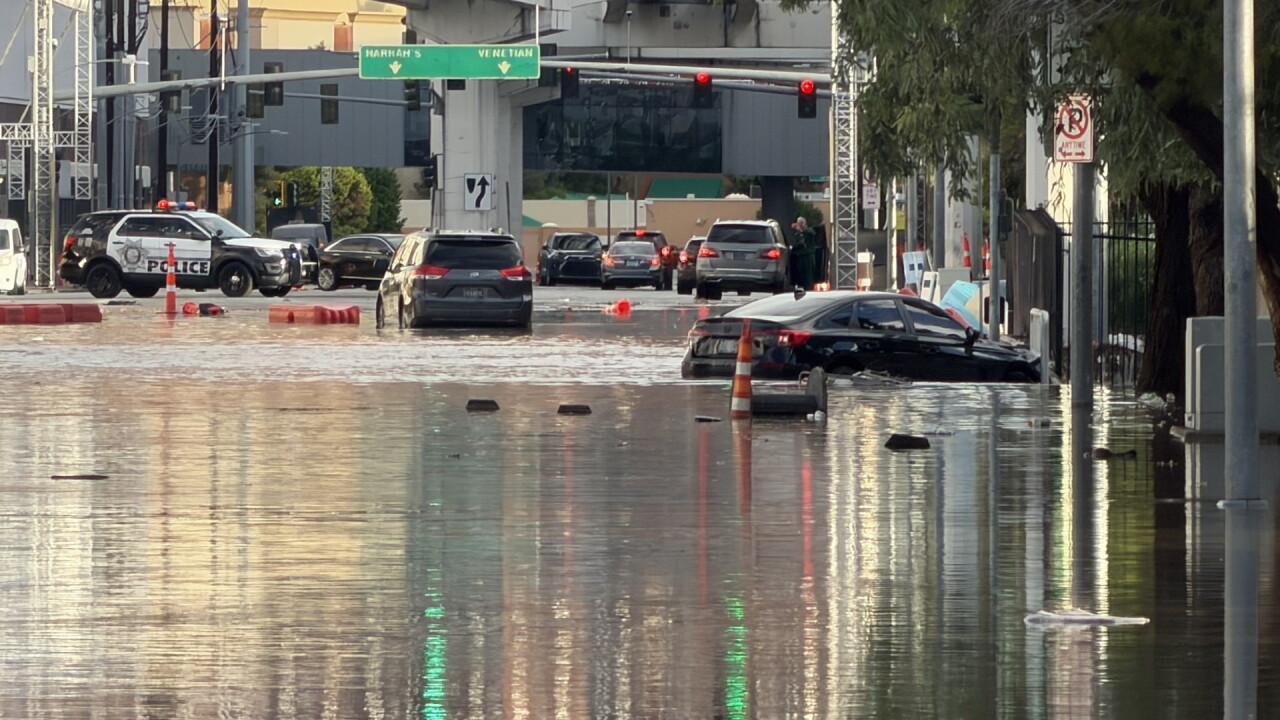
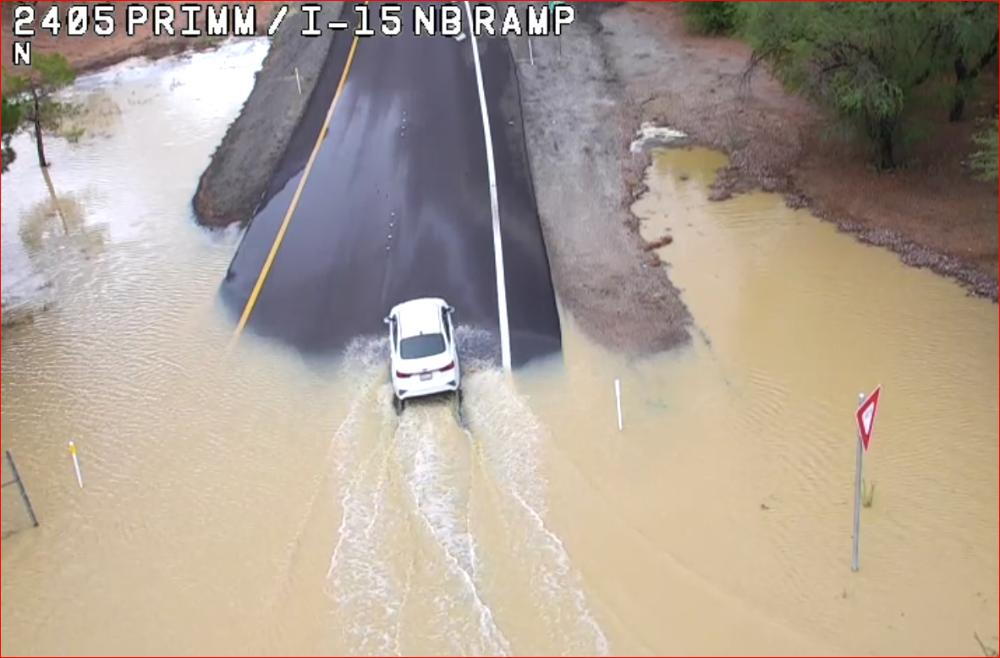
Flooding hit some busy spots. KTNV reported that Koval Lane and Winnick Avenue, just east of the Strip, flooded and closed. Water also pooled in the area behind The LINQ and near the Rio. Farther south, the Regional Transportation Commission (RTC) closed all lanes of Primm Boulevard at I-15 near the California state line, where a traffic camera showed a car driving through brown water that covered the road shoulders.
The wind was the second half of the storm. FOX5 reported a Wind Advisory for the Las Vegas valley through early Monday morning, with gusts of 45 to 55 mph. A High Wind Warning covered the Spring Mountains and eastern Clark County, with gusts of 60 to 70 mph possible. Forecasters warned of power outages and wind damage and told people to tie down loose items outside. A valley-wide Flood Watch and the Wind Advisory both ran until 5 a.m. Monday, according to KTNV.
Travelers felt it too. On Saturday, October 10, Harry Reid International Airport warned that flights on Sunday and Monday could be delayed by weather in Las Vegas and nearby areas, and asked passengers to check with their airline for updates. FOX5 headlines over the weekend also reported several outdoor events that were canceled or cut short because of high winds and rain, including the final day of the Age of Chivalry festival.
Why It Matters to Las Vegas Residents
Most of the year, Las Vegas residents do not think about rain at all. That is exactly why a day like Sunday catches people off guard. Our soil is hard and rocky, and a lot of the valley is covered in roofs, driveways, and pavement. When an inch of rain falls in a few hours, very little of it soaks in. It runs off fast, into streets, washes, and low spots.
For commuters, that means roads you drive every day can turn into small rivers with little warning. Koval Lane is a back way that many locals use to dodge Strip traffic. Primm Boulevard at I-15 is the route for anyone heading to the state line. Both closed on Sunday. If you work early shifts on or near the Strip, you likely found out about the flooding the hard way.
For homeowners, a storm like this is a stress test. A heavy rain is the one time of year your roof, gutters, stucco, windows, and yard drainage all get tested at once. Flat roofs and older tile roofs can show small leaks that stay hidden all summer. Backyards that slope toward the house can send water toward the foundation or into a garage. Pool owners may see their water level jump and their pool full of debris from the wind.
The wind matters too. Gusts of 45 to 55 mph are strong enough to knock down weak tree limbs, tip over patio furniture, and loosen roof tiles. If you lost power for a bit on Sunday, the wind was the likely cause, not the rain. And because the heaviest totals landed in the northwest valley, neighborhoods in and around Centennial Hills got hit harder than much of Henderson or the east side.
For renters, it is a good reminder that a landlord's insurance covers the building, not your stuff. If water came in under a door or through a window, take photos right away and report it in writing. For buyers and sellers in the middle of a deal, a rain event can turn up issues that an inspection in dry weather would miss, which is useful to know either way.
There is also a simple money side to all of this. Water damage that gets found early is usually a small repair. Water damage that sits inside a wall or under flooring for months can turn into a much bigger bill, and it can show up later as a problem when you sell. A storm like Rachel gives every homeowner in the valley a free chance to spot issues while they are still small.
Background and History
Las Vegas is one of the driest big cities in the country. Based on the National Weather Service's 1991 to 2020 normals, the airport averages just 4.18 inches of rain in a full year. October normally brings 0.32 inches. February is usually the wettest month at 0.80 inches, and June is the driest at 0.04 inches. Daily rain records at the official station go back to January 1, 1937.
Put those numbers next to Sunday's 1.08 inches, and the scale gets clear. One fall day brought about a quarter of a normal year's rain to the airport. Parts of the northwest valley got more than half a normal year's rain in one storm.
Big rain days are rare here, but they are not new. KTNV reported that on Valentine's Day in 2019, the airport, then called McCarran, recorded 1.11 inches by 7 p.m. That broke a daily record from 1980. That storm closed parts of Las Vegas Boulevard and Charleston Boulevard and led to four water rescues from flood channels.

The reason storms like that usually do less damage than they once did is the Clark County Regional Flood Control District. It was formed in 1985 after a series of damaging floods, and it is funded by a small share of local sales tax. Over the decades, it has built a large network of detention basins and flood channels designed to catch storm runoff and move it safely toward Lake Mead. When KTNV reported on the district in 2019, it had built 93 detention basins and 619 miles of channels, about 75 percent of its master plan, with more work planned as the valley grows.
Those basins are the big dirt bowls you may see near parks or along the 215. On a normal day they look like empty fields. On a day like Sunday, they are doing their job. The same goes for the concrete channels that run behind many neighborhoods. They are built to fill up fast during a storm, which is exactly why they are dangerous places to be when it rains.
It is also worth knowing why tropical storms reach us at all. Tropical storms form far to our south and usually weaken long before they get near Nevada. But their leftover moisture can ride the winds north, and when it runs into our mountains and desert heat, it can wring out heavy rain. That is what happened with Rachel. The storm itself stayed far away, but its moisture made a record day here.
What Happens Next
The storm itself is over, and the forecast now turns cool and calm. FOX5 forecast a Monday high of 69 degrees with scattered showers and isolated thunderstorms possible, and breezy conditions lingering into the early morning. Tuesday is expected to be the coolest day of the week, with a high of 67, overnight lows in the 50s, and only a slight chance of showers.
From Wednesday through Saturday, sunshine is expected to return with highs in the 70s. Friday could be breezy at times. For most locals, that is the first real taste of fall weather this year, and a big change from the 98 degrees the valley saw on Thursday.
In the days after a storm like this, watch for cleanup work. Roads that flooded often have mud, rocks, and debris left behind, and some low crossings may stay rough for a while. If you see a flood-related problem, such as a blocked storm drain or a damaged channel, the Regional Flood Control District has an online form to report it. Utility crews may also still be handling wind damage in spots that lost power.
Longer term, this storm will become part of the record books. When people look back at Las Vegas weather in 2026, October 11 will show up as a record day at the airport. The flood control district will also use the data from its rain gauges to see how its basins and channels handled the runoff.
If you had damage, the next week or two is the time to act. Insurance companies usually want claims reported quickly, and contractors who handle roofs and water cleanup tend to get busy right after a storm. Getting on a list early can make a real difference in how fast your home gets back to normal.
Ryan's Take
As a Las Vegas agent, I tell clients that a rainy day is one of the best days to look at a house. You learn things you will never see in July. You can see where water pools in the yard, whether the gutters overflow, and whether the street out front drains or turns into a pond. If you are buying right now and your inspection already happened in dry weather, it is fair to drive by the house after a storm like this one and just look. If something seems off, talk to your agent and inspector about it while you still have options.
For sellers, the same idea works in your favor. Walk your property this week. Check ceilings for new water stains, look at the base of exterior walls, and clean out anything the wind blew into your yard or pool. Fixing a small roof leak now is much cheaper than finding it during a buyer's inspection. And for anyone shopping in the northwest valley or near a wash, ask where the home sits on the flood zone map. Most homes in the valley are not in a high-risk flood zone, but knowing for sure is part of buying smart. Storms like Rachel are rare here, but they remind us that desert living still comes with weather.

What You Can Do
First, check your home now while the storm is fresh. Look at ceilings, especially near skylights, vents, and corners. Check window sills and the bottom of sliding doors for water. Walk the outside of the house and look for spots where water pooled against the walls. Clear debris from gutters, roof valleys, and pool skimmers. If you find damage, take dated photos before you clean up, then call your insurance company.
Second, know your flood risk. The Clark County Regional Flood Control District has a free "Am I in a Flood Zone?" tool on its website, plus a live rainfall map that shows totals from its rain gauges across the valley. It is worth knowing that FEMA says most standard homeowners insurance policies do not cover flood damage. Flood insurance is a separate policy, and it usually takes about 30 days to start, so you cannot wait until the next storm is in the forecast to buy it.
Third, plan for the next one. Never drive into a flooded road or wash. Water that looks shallow can hide a washed-out road or move fast enough to push a car. Tie down patio furniture, trampolines, and trash cans when a Wind Advisory goes out. Sign up for weather alerts on your phone, and if you are flying during a storm, check with your airline before heading to Harry Reid. A few small steps now can save you a big headache later.
Finally, if you live in an HOA community, let your management company know about any flooding you saw in common areas, streets, or walls. Drainage in shared spaces is usually the HOA's job, and they can only fix what they know about. If you are a renter, send your landlord a short written note with photos so there is a record. And if you are thinking about buying or selling this fall, use this storm as a checklist moment. Write down anything you noticed, so you can fix it, disclose it, or ask about it before it becomes part of a negotiation.

Have questions about how this affects your home or neighborhood? Reach out to Ryan Rose or text/call 702-747-5921 anytime.
Sources
FOX5 Vegas: "FIRST ALERT: Tropical moisture from Rachel brings wettest day in a year to Las Vegas"
KTNV 13: "VIDEO: Rain from Tropical Storm Rachel causes flooding across Las Vegas valley"
FOX5 Vegas: "Weather may cause flight delays at Harry Reid Airport Sunday and Monday"
National Weather Service Las Vegas: Precipitation Overview (1991 to 2020 normals)
KTNV 13: Flood control planning shows success in record-setting Las Vegas winter storm
Clark County Regional Flood Control District
FEMA: Flood insurance coverage and the 30-day waiting period
Categories
- All Blogs (4979)
- Absentee Owner (4)
- Affordability (3)
- ALIANTE (53)
- Anthem (33)
- Ascension (50)
- Assumable Loan (1)
- Astra (50)
- BLACK MOUNTAIN (55)
- Buyers (22)
- Cadence (17)
- Calico Ridge (50)
- Canyon Fairways (50)
- CANYONS OF SUMMERLIN (55)
- CENTENNIAL HILLS (81)
- Comparisons (46)
- CROSSINGS IN SUMMERLIN (55)
- DESERT SHORES (47)
- Divorce (3)
- Downsizing (13)
- EAGLE HILLS (55)
- Empty Nester (1)
- Enterprise (1)
- EXPIRED LISTINGS (134)
- First Time Homebuyer (4)
- Green Valley (139)
- Henderson (82)
- HORIZONS EDGE (50)
- Housing Market Trends (100)
- Informative (112)
- Inspirada (58)
- Lake Las Vegas (2)
- Lakes Las Vegas (3)
- Las Vegas Real Estate (182)
- Local News (774)
- Luxury (1)
- MacDonald Highlands (88)
- MacDonald Ranch (100)
- Madeira Canyon (93)
- MESQUITE NV (103)
- MOUNTAIN TRAILS (50)
- Mountains Edge (79)
- Naked City (35)
- New Construction (131)
- North Las Vegas (24)
- Northgate (23)
- PALISADES SUMMERLIN (50)
- Probate (28)
- Providence (2)
- Quail Ridge (35)
- QUEENSRIDGE (56)
- Red Rock (1)
- RED ROCK COUNTRY CLUB (60)
- Relocating to Summerlin (207)
- Relocation (45)
- Retired (1)
- Retirement (1)
- Reverence (15)
- RHODES RANCH (64)
- Ridgebrook (40)
- Sellers (255)
- Seven Hills (83)
- Silverado Ranch (1)
- Silverstone Ranch (39)
- SKYE CANYON (100)
- SKYE CANYONE (4)
- Southern Highlands (94)
- Southwest (19)
- SPANISH TRAILS (55)
- SPRING VALLEY (70)
- Summerlin (104)
- Sun City Summerlin (3)
- The Arbors (37)
- The Cliffs (50)
- THE HILLS (55)
- THE PASEOS (55)
- The Pueblos (27)
- THE PUEBLOS OF SUMMERLIN (42)
- THE RIDGES (65)
- THE VISTAS OF SUMMERLIN (50)
- The Willows (60)
- Thoughts on Home Tour (2)
- TOURNAMENT HILLS (50)
- Veterans (3)
- WHITNEY RANCH (55)
- Workers Advantage Program (100)
Recent Posts









GET MORE INFORMATION