
Home Flipping Fell to 6.2 Percent of Sales Nationally. In Nevada It Is 7.7 Percent
Related Stories
Mom-and-Pop Investors Bought About 48,000 Las Vegas Homes in a Decade
A Las Vegas Investor Bought a Home Sold as an Income Rental, and Now the City Wants $41,500
House flipping is cooling off across the country, but Nevada is still flipping more than most. According to property data company ATTOM, flips made up 6.2% of all U.S. home sales in the second quarter of 2026. In Nevada, the rate was 7.7%, with 1,213 homes flipped and a typical gross profit of $66,125 per flip.
That gap matters if you are shopping for a home in Las Vegas or Henderson. It means flippers are a bigger part of the Nevada market than the national headline suggests. And national real estate news is not local real estate news. The U.S. number says flipping is fading. The Nevada number says flippers are still very much in the game here, even as their profits shrink.
In this post, we will walk through what ATTOM found, what it means for Southern Nevada buyers and sellers, and the simple checks you can run before you buy a house that was just flipped.
What Happened
On Oct. 1, 2026, ATTOM released its second-quarter home flipping report, titled "Home Flipping Profits Continue Gradual Two-Year Decline." ATTOM counts a home as a flip when it sells in an arms-length sale and the same home also sold in an arms-length sale within the prior 12 months. The study covers single-family homes and condos.
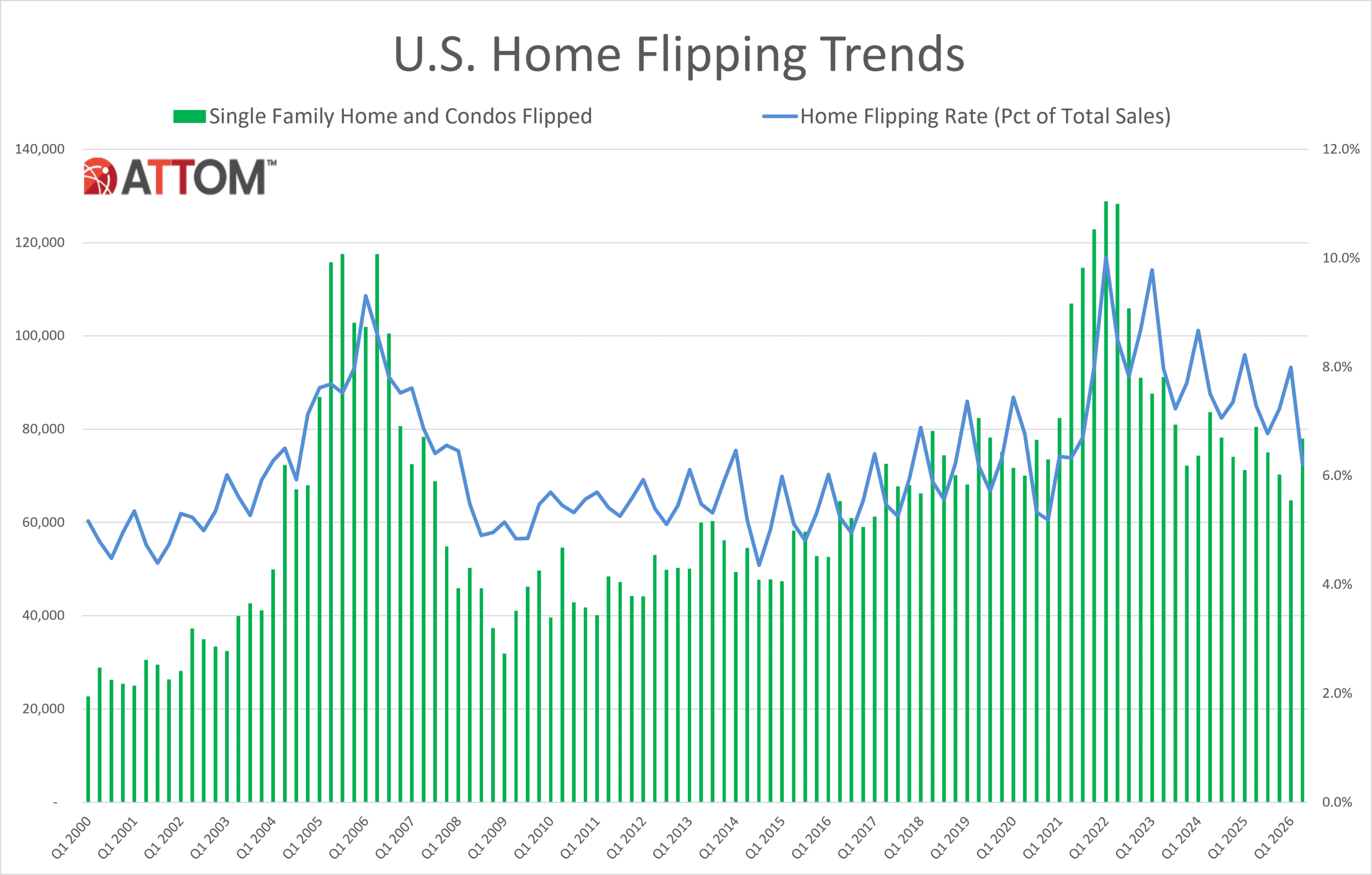
Nationally, ATTOM counted 77,991 flips from April through June. That was 6.2% of all home sales. It was down from 8.0% in the first quarter and down from 7.3% in the second quarter of 2025. The raw count actually rose from 64,760 flips in the first quarter, because more homes sold overall in the spring. But compared with a year earlier, when there were 80,477 flips, the count was lower.
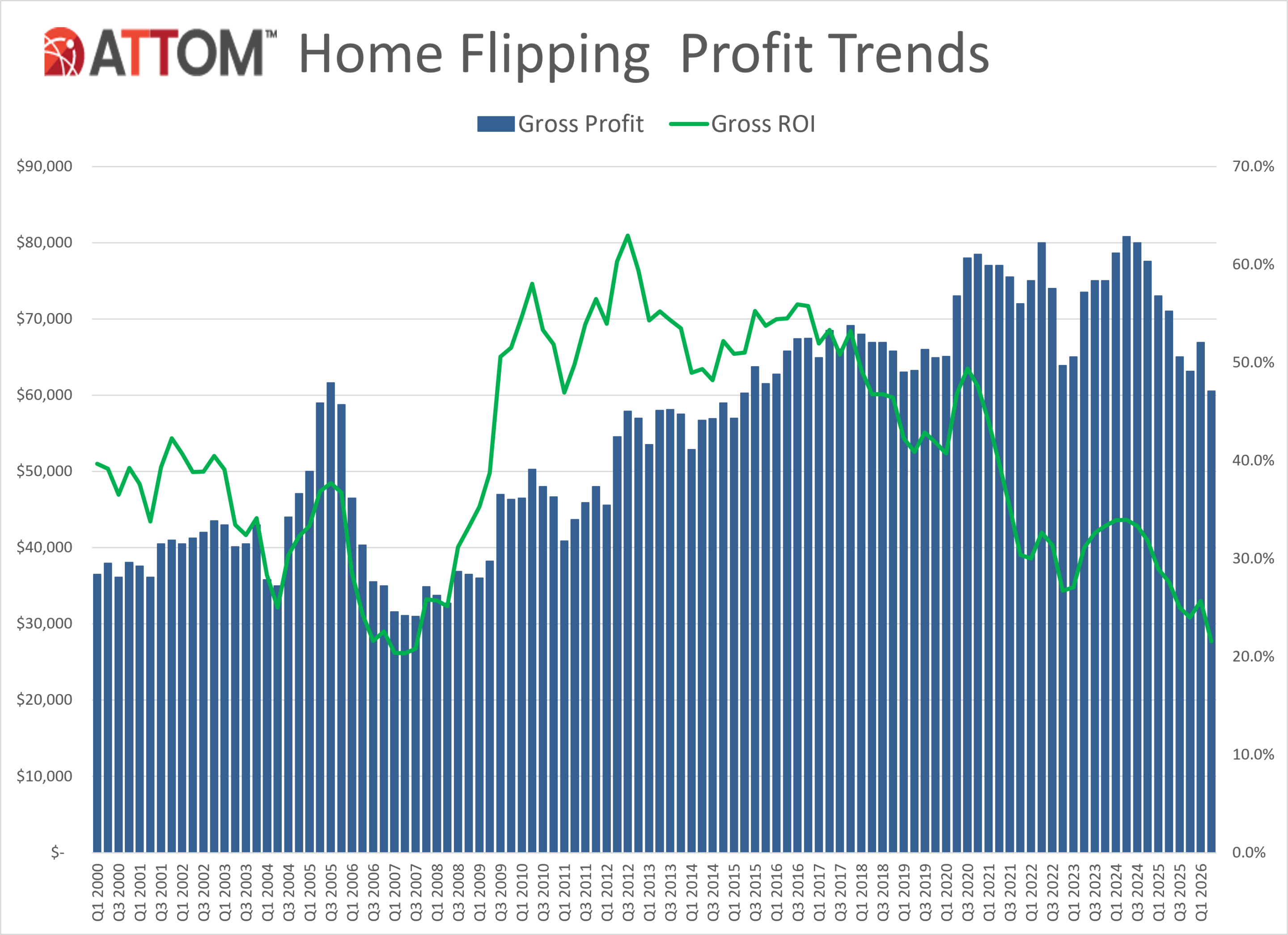
Profits slipped too. The typical gross profit on a U.S. flip was $60,526. That was down from $66,932 in the first quarter and about $71,000 a year earlier. The typical profit margin fell to 21.5%, from 25.7% last quarter and 27.6% a year ago. ATTOM CEO Rob Barber said flippers "are still making money in most markets, but the typical return continues to narrow." Flippers also moved a little faster. The typical flip took 161 days from purchase to resale, down from 166 days a year earlier.
The slowdown was widespread. ATTOM looked at 186 metro areas with enough data. The flip rate fell from the prior quarter in 162 of them, or 87.1%, and fell from a year earlier in 131 of them. Profit margins dropped from the prior quarter in 126 metros. ATTOM also tracked who buys flipped homes. About 10.7% of flipped homes sold to buyers using FHA loans, up from 10.1% in the first quarter but down from 12.3% a year earlier. FHA loans are popular with first-time buyers because they allow a smaller down payment.
One day later, on Oct. 2, ATTOM posted its state-by-state breakdown for the second quarter. That is where the Nevada numbers come from. Nevada had 1,213 flips and a flip rate of 7.7%. The typical gross profit was $66,125, down from $67,500 a year earlier. The typical gross return on investment was 16.1%, down from 18.1% a year earlier. ATTOM did not break out Clark County or the Las Vegas metro area in either report. A Las Vegas-only flip rate for the quarter is [NOT VERIFIED].
Why It Matters to Las Vegas Residents
Start with the gap. Nevada's 7.7% flip rate is 1.5 percentage points above the national 6.2%. Put simply, about 1 in every 13 Nevada home sales in the quarter was a flip. Nationally it was closer to 1 in 16. Nevada did not lead the country. Ohio had the highest state flip rate at 9.6%, and neighboring Arizona came in at 8.4%. But Nevada sits well above the middle of the pack, and above California and Utah.
Since most of Nevada's home sales happen in Clark County, it is fair to expect that Las Vegas, Henderson and North Las Vegas account for a large share of those 1,213 flips. The exact Clark County count is [NOT VERIFIED], because ATTOM only published the statewide figure. Still, if you are house hunting in Southern Nevada, there is a real chance some of the homes on your list were bought and resold within the last year.
For buyers, that cuts two ways. A flipped home can be a great option. It is often move-in ready, with fresh paint, new flooring, and an updated kitchen or bath. For a busy family or a first-time buyer who does not want a project, that is a big plus. But a flipped home also has a short ownership history. The seller may have owned it for only a few months, and may know less about the home than a long-time owner would. The work may be beautiful on the surface and rushed underneath. That is why checking a flip carefully matters more than usual.
Flippers also compete with regular buyers for the same homes. The homes flippers want are usually ones that need work and are priced below nearby updated homes. Those are often the same homes a first-time buyer with a tight budget is looking at. When investors show up with cash and fast closings, a buyer using a loan can have a harder time winning that house.
The FHA number is worth a second look. Roughly 1 in 10 flipped homes nationally sold to an FHA buyer. FHA appraisals come with their own property standards, and FHA has rules about financing a home that the seller has owned for only a short time [NOT VERIFIED for current details]. If you plan to use an FHA loan, ask your lender early whether a recent flip could raise any issues. It is much better to learn that before you write an offer than in the middle of escrow.
For sellers, the numbers tell a different story. If your home is dated and you want to sell as-is, a flipper may be one of your likely buyers. Knowing that Nevada flippers are making smaller profits than a year ago helps explain why their offers can feel low. They have to leave room for repairs, holding costs, and a resale price that is not climbing the way it did a few years ago.
Background and History
ATTOM describes the second quarter as part of a two-year slide in flipping profits. Margins and gross profits have trended down since about 2024. That lines up with a period of higher mortgage rates and slower home price growth across much of the country. When resale prices stop rising quickly, a flipper's profit has to come mostly from the repairs, not from the market lifting everything.
It is important to know what "gross profit" means here. ATTOM figures gross profit by subtracting the purchase price from the resale price. It does not take out the cost of repairs, loan interest, taxes, insurance, utilities or agent fees. ATTOM notes that flippers often estimate rehab and other costs at 20% to 33% of the after-repair value. So a typical gross profit of $66,125 in Nevada does not mean the flipper pocketed $66,125. After costs, the real profit can be much smaller, and on some flips it can disappear.
The purchase price also matters a lot. Nationally, ATTOM found that flips bought for $100,000 to $200,000 had the strongest typical returns, around 28%. Flips bought for $300,000 to $400,000 returned about 20%. Homes bought for $50,000 or less actually lost money in the typical case. Las Vegas homes cost more than the national average, which helps explain why Nevada's typical return of 16.1% is lower even though its dollar profit is higher than the U.S. figure. These are different measures, so the national margin and the Nevada return should not be compared directly.
ATTOM also ranked the big metro areas, those with more than 1 million people. Cleveland had the highest flip rate at 10.4%, followed by Columbus, Ohio, and Memphis at 9.5%, Dallas at 9.4%, and Phoenix at 8.9%. The lowest big-metro rates were in Rochester, New York, at 2.7%, and Seattle and Washington, D.C., at 4%. Las Vegas did not appear on either list in ATTOM's summary, and its own metro rate is [NOT VERIFIED]. On profit, several Texas metros were barely breaking even. San Antonio flippers lost money in the typical case, and Dallas, Austin and Houston margins were under 4%. That is a useful reminder that flipping is not a sure thing, even in hot Sun Belt markets.
Nevada's neighbors show how fast things can change. Arizona's typical gross profit fell to $40,436 from $53,999 a year earlier. Utah's fell to $19,684 from $26,049, with a return of just 3.9%. California's profit dropped to $75,000 from $114,000. Compared with those, Nevada's slide from $67,500 to $66,125 was small. Profits here held up better than in most of the West, which may be part of why flippers are still active.
What Happens Next
ATTOM publishes its flipping report every quarter. The third-quarter numbers, covering July through September 2026, would normally come out around the end of the year [NOT VERIFIED]. That report will show whether Nevada's flip rate is holding near 7.7% or starting to follow the national rate down. It will also show whether the typical Nevada profit keeps sliding.
There is one data caution to keep in mind. ATTOM says it expanded its property record coverage in 2026, so some changes in flip counts may reflect better data, not just more or fewer flips. That means it is smart to watch the trend across several quarters instead of reading too much into one jump or drop.
On the local side, the bigger forces are the same ones shaping the rest of the Las Vegas market. Mortgage rates are still high, more homes are for sale than a year ago, and buyers have more choices. When buyers have more choices, a flipped home has to stand out on price and quality to sell fast. A flipper who bought at the wrong price, or who has to cut the asking price, can see that $66,125 typical gross profit shrink quickly. If that happens across many flips, it is reasonable to expect fewer investors bidding on fixer-uppers in the months ahead, but that is a forecast, not a finding in the ATTOM data.
Ryan's Take
The headline number is a good reminder that Southern Nevada does not move in lockstep with the rest of the country. Nationally, flipping is shrinking. Here, flippers are still a bigger slice of sales than the U.S. average, and their profits have held up better than in Arizona, Utah or California. That tells you investors still see value in Las Vegas homes that need work. It also tells first-time buyers that the fixer-upper with good bones may draw a cash offer from someone with a contractor on speed dial.
None of this makes a flipped house a bad buy. Plenty of flips are done well, with permits and quality work. The point is that a flipped home deserves the same careful look as any other home, plus a few extra questions about what was done, who did it, and when. Shrinking flipper profits can also work in a buyer's favor. A flipper who is carrying a loan and a monthly holding cost may be more open to negotiating on price or repairs than a seller who has lived in the home for 20 years and is in no hurry.

What You Can Do
If you are buying, check the sales history first. Look at when the home last sold and for how much. If it sold within the past year, it is likely a flip. Listing sites like Zillow and Redfin often show past sales, and the Clark County Assessor's website lets you look up a parcel's ownership and value records. A short gap between sales and a big jump in price is your cue to ask more questions.
Ask what work was done, and whether it was permitted. Ask the seller for a list of repairs and upgrades, plus any receipts or warranties. Ask whether permits were pulled for electrical, plumbing, HVAC or structural work. Clark County, the City of Las Vegas, Henderson and North Las Vegas each handle building permits for their own areas, so the right office depends on where the home sits. Nevada sellers also generally must provide a Seller's Real Property Disclosure form. Read it closely, since a seller who owned the home for a few months may have little history to share.
Use the timeline when you negotiate. Nationally, the typical flip took 161 days from purchase to resale. Every extra month a flipped home sits on the market costs the investor in loan payments, utilities, insurance and taxes. If a flip has been listed for a while, that holding cost is real, and it can give you room to ask for a lower price, seller-paid closing costs, or a repair credit. Your agent can pull how long the home has been listed and whether the price has already been cut.
Get a full inspection, and look past the paint. New finishes can hide old problems. Have the inspector pay special attention to the roof, the AC system, the water heater, the electrical panel, and signs of water damage under sinks and around showers. In our desert heat, an older AC unit dressed up with a new thermostat is something worth knowing about before you close. If anything looks off, consider a specialist, like an HVAC tech or a roofer. And if you are selling a dated home, compare a flipper's as-is offer against what the home could sell for on the open market, so you know what the convenience is costing you.

Have questions about how this affects your home or neighborhood? Reach out to Ryan Rose or text/call 702-747-5921 anytime.
Sources
ATTOM, "Home Flipping Profits Continue Gradual Two-Year Decline" (Oct. 1, 2026)
ATTOM, "U.S. Home Flipping Trends by State, Q2 2026" (Oct. 2, 2026)
Categories
- All Blogs (4979)
- Absentee Owner (4)
- Affordability (3)
- ALIANTE (53)
- Anthem (33)
- Ascension (50)
- Assumable Loan (1)
- Astra (50)
- BLACK MOUNTAIN (55)
- Buyers (22)
- Cadence (17)
- Calico Ridge (50)
- Canyon Fairways (50)
- CANYONS OF SUMMERLIN (55)
- CENTENNIAL HILLS (81)
- Comparisons (46)
- CROSSINGS IN SUMMERLIN (55)
- DESERT SHORES (47)
- Divorce (3)
- Downsizing (13)
- EAGLE HILLS (55)
- Empty Nester (1)
- Enterprise (1)
- EXPIRED LISTINGS (134)
- First Time Homebuyer (4)
- Green Valley (139)
- Henderson (82)
- HORIZONS EDGE (50)
- Housing Market Trends (100)
- Informative (112)
- Inspirada (58)
- Lake Las Vegas (2)
- Lakes Las Vegas (3)
- Las Vegas Real Estate (182)
- Local News (774)
- Luxury (1)
- MacDonald Highlands (88)
- MacDonald Ranch (100)
- Madeira Canyon (93)
- MESQUITE NV (103)
- MOUNTAIN TRAILS (50)
- Mountains Edge (79)
- Naked City (35)
- New Construction (131)
- North Las Vegas (24)
- Northgate (23)
- PALISADES SUMMERLIN (50)
- Probate (28)
- Providence (2)
- Quail Ridge (35)
- QUEENSRIDGE (56)
- Red Rock (1)
- RED ROCK COUNTRY CLUB (60)
- Relocating to Summerlin (207)
- Relocation (45)
- Retired (1)
- Retirement (1)
- Reverence (15)
- RHODES RANCH (64)
- Ridgebrook (40)
- Sellers (255)
- Seven Hills (83)
- Silverado Ranch (1)
- Silverstone Ranch (39)
- SKYE CANYON (100)
- SKYE CANYONE (4)
- Southern Highlands (94)
- Southwest (19)
- SPANISH TRAILS (55)
- SPRING VALLEY (70)
- Summerlin (104)
- Sun City Summerlin (3)
- The Arbors (37)
- The Cliffs (50)
- THE HILLS (55)
- THE PASEOS (55)
- The Pueblos (27)
- THE PUEBLOS OF SUMMERLIN (42)
- THE RIDGES (65)
- THE VISTAS OF SUMMERLIN (50)
- The Willows (60)
- Thoughts on Home Tour (2)
- TOURNAMENT HILLS (50)
- Veterans (3)
- WHITNEY RANCH (55)
- Workers Advantage Program (100)
Recent Posts








GET MORE INFORMATION