
Lilli Tasting Menu Moves to Chinatown Las Vegas | Ryan Rose

Spring Mountain Road in Las Vegas's Chinatown corridor, where Lilli will soon open its permanent home at Suite 101.
Las Vegas has no shortage of restaurants that promise an experience, but genuine fine dining rooted in classical training and executed at the highest level remains relatively rare outside the Strip. That equation shifted meaningfully when chef Tyler Vorce brought his concept Lilli to the Durango Social Club on the west side of the valley in late 2025. And now, with that six-month residency complete, Lilli is moving to a permanent address: 3616 Spring Mountain Road, Suite 101, in the heart of Las Vegas's Chinatown.
For anyone paying attention to where the city's culinary energy is actually building, this is a notable moment. A chef with serious pedigree is planting a flag in one of Las Vegas's most vibrant and walkable neighborhoods, and doing it outside the casino ecosystem entirely. That combination is worth understanding in full, whether you follow food closely or you are simply trying to decide where in the valley you want to live and build your life.
What Lilli Is and Why It Matters
Lilli is a seven-course tasting menu concept. That description can mean many things in contemporary American dining, ranging from an austere intellectual exercise to a warm, personal meal that happens to be composed with real precision. Chef Vorce's version earned strong attention during its residency run, drawing diners from across the valley and generating coverage in both the Las Vegas Review-Journal's Neon section and Las Vegas Weekly.
A tasting menu at its best is a kind of storytelling. Each course builds on the one before it, and the chef controls the pace, the temperature, and the arc of the evening. Done well, it is one of the most memorable ways to spend a few hours at a table. Done poorly, it is expensive and exhausting. The fact that Lilli built enough of an audience during a residency format, which is inherently temporary and limited in scope, to justify a permanent brick-and-mortar location says something real about the quality of the cooking and the loyalty of the guests it found.
Opening a permanent restaurant in Las Vegas is not a small commitment. Rents on Spring Mountain Road reflect a corridor that has become one of the most desirable dining addresses in Clark County. The decision to sign a long-term lease there after a successful residency suggests Vorce and the team behind Lilli have conviction in both the concept and the neighborhood.
Who Is Tyler Vorce and Where He Came From
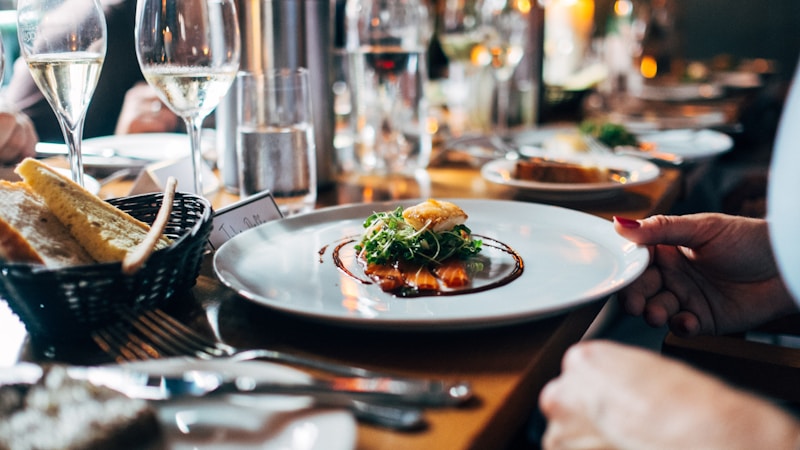
The kind of precise, composed plating that defines a seven-course tasting menu experience like the one Lilli has built its reputation on.
Tyler Vorce trained at The French Laundry, Thomas Keller's three-Michelin-star restaurant in Yountville, California. That is not a casual line on a resume. The French Laundry is widely considered one of the most demanding and technically rigorous kitchens in the United States, and the chefs who come out of it carry a specific standard with them.
Thomas Keller's influence on American fine dining is broad and well-documented. His approach to classical French technique, applied to California ingredients and expressed through the tasting menu format, shaped an entire generation of cooks. When a chef trained in that environment decides to open their own concept, the baseline expectation among serious diners is high.
Vorce's decision to bring that training to Las Vegas rather than to a more traditional fine dining market like New York, San Francisco, or Los Angeles reflects something real about where this city is in its culinary evolution. Las Vegas is no longer simply a place where great chefs open satellite outposts of their primary restaurants elsewhere. It is becoming a place where talented cooks build their primary work from the ground up.
That shift matters for the people who live here. For years, the complaint about Las Vegas dining was that the city had plenty of celebrity chef brands but relatively few restaurants with a genuine sense of place and a chef who was actually present in the kitchen night after night. That criticism has eroded steadily, and chefs like Vorce are part of the reason why.
The Six-Month Durango Residency and What It Proved
The residency model has become a useful tool for chefs testing concepts in new markets. Rather than committing immediately to a permanent space, a chef can operate within an existing venue for a defined period, build an audience, refine the menu, and decide whether the city is ready for what they are offering. If the answer is yes, as it clearly was for Vorce, the next step is a permanent home.
Lilli ran its residency at the Durango Social Club, part of Station Casinos' Durango Casino and Resort on the west side of Las Vegas. The residency concluded on June 7, 2026, after six months of operation. That timeline gave Vorce enough runway to establish the concept, attract regulars, and generate the kind of press coverage that builds a reservation list ahead of a new opening.
Station Casinos properties, including Durango, have made a deliberate effort to bring interesting food and beverage programming to a more local, residential audience. The Durango Social Club was a thoughtful host for an ambitious tasting menu concept. That said, a casino-adjacent residency and a standalone restaurant in a neighborhood dining corridor serve different audiences in meaningfully different ways. The move to Spring Mountain Road is not just a change of address. It is a change in the kind of experience Lilli can offer and the kind of relationship it can build with its guests.
A permanent restaurant allows a chef to invest in the physical environment, to train a team that stays together long enough to develop genuine fluency, and to build the kind of institutional knowledge that makes a great restaurant feel like itself on any given night. The residency proved demand. The permanent location is where the real work begins.
What the Chinatown Location Means

The Spring Mountain Road corridor has grown into one of Las Vegas's most active dining and retail destinations, drawing locals and visitors alike throughout the week.
The address, 3616 Spring Mountain Road Suite 101, sits in a section of Las Vegas that has transformed over the past two decades into one of the city's most culturally rich and culinarily diverse corridors. Las Vegas's Chinatown is not a single block or a theme park version of an ethnic neighborhood. It is a living, growing stretch of Spring Mountain Road and the surrounding streets where dozens of independently owned restaurants, bakeries, grocery stores, and specialty shops coexist and, in many cases, thrive.
You can find some of the best ramen, dim sum, Korean barbecue, Vietnamese pho, and Taiwanese shaved ice in the entire Southwest within a short walk of any given address on that stretch of road. Adding a seven-course French-influenced tasting menu to that mix is not a contradiction. It is exactly the kind of range that makes a neighborhood worth living in and worth visiting repeatedly.
For Lilli, the location offers something that no Strip address and no casino residency can fully replicate: the feeling of being part of a neighborhood. Guests walking to dinner past a roast duck window and a Hong Kong-style cafe before arriving at a white-tablecloth tasting menu room will have an experience that is distinctly Las Vegas. That layering of culinary cultures within a walkable area is one of the things that makes this corridor genuinely special.
The Spring Mountain Road corridor also has a loyal, repeat customer base that is almost entirely made up of local residents. The tourists who find their way there are welcomed, but the backbone of the business is the people who live in the surrounding neighborhoods and treat these restaurants as their own. A tasting menu concept that earns a place in that ecosystem has built something durable.
Ryan's Take
When I talk with clients who are considering a move to the Las Vegas valley, the conversation about neighborhoods covers a lot of ground. We talk about commute times, school options, proximity to family, and price points. But for a growing number of people, the question of what their daily life will look and feel like, specifically what is within reach on a Tuesday night when they want a great meal without driving to the Strip, has become a real factor in the decision.
The Chinatown corridor on Spring Mountain Road is one of the strongest answers I can give to that question. It is accessible from a wide range of neighborhoods in the central and western parts of the valley. It is walkable by Las Vegas standards, meaning you can park once and explore on foot. And it keeps getting better, not because of a single developer or a master plan, but because individual operators keep choosing it as the right place to build something serious.
Lilli joining that corridor permanently is another data point in a consistent trend. Talented people with real culinary ambition are choosing to build their primary work in Las Vegas, and they are doing it in neighborhoods where local residents are the intended audience. That is good for the city and, I would argue, it is a genuine quality-of-life consideration for anyone thinking about where to put down roots in Clark County.
If you are weighing neighborhoods and the ability to walk or make a short drive to genuinely exceptional restaurants is part of what you are looking for, the areas surrounding Spring Mountain Road deserve a close look. Homes in the zip codes that feed into this corridor have consistent demand, and the dining and retail environment that surrounds them is one of the reasons why.
What the Chinatown Food Scene Means for Buyers and Residents

Residential streets near the Chinatown corridor offer proximity to one of Las Vegas's most active dining and cultural destinations.
Real estate value is driven by many factors, and walkable amenities are among the most consistently valued across buyer demographics. Proximity to good food, independent retail, and cultural activity is not a luxury preference for a niche buyer profile. It is a broad preference that shows up in both buyer behavior and pricing data across markets nationwide.
Las Vegas's Chinatown has been building the kind of amenity density that supports elevated real estate interest for years. The arrival of a restaurant like Lilli, a chef-driven tasting menu concept with serious culinary credentials, adds to a portfolio of dining options that already includes destinations drawing guests from across the entire valley and beyond.
For buyers considering the neighborhoods that surround the Spring Mountain Road corridor, including areas in the 89102, 89117, and adjacent zip codes, the dining and cultural environment is a genuine draw. Renters in the area cite access to the corridor as a quality-of-life benefit, and buyers who prioritize that kind of urban texture in a city that has historically been more suburban than walkable are paying attention to this stretch of the valley more than they were even five years ago.
It is also worth noting that the Chinatown corridor and the surrounding neighborhoods are accessible from a wide range of price points. This is not an enclave that requires a luxury budget to live near. Entry-level condos, mid-range single-family homes, and higher-end properties all exist within reasonable proximity. The appeal is broad, and that breadth tends to support neighborhood stability over time.
If you are curious about what is available near Spring Mountain Road right now, or if you want to talk through how proximity to amenities like the Chinatown dining corridor fits into your search criteria more broadly, I am happy to walk through the current inventory with you. The market moves, but the fundamentals of this corridor's appeal are durable.
Curious about living near Las Vegas's Chinatown or anywhere else in the valley where the food and culture are genuinely worth your time? Reach out and let's talk through what is available and what fits what you are looking for. There is no pressure and no obligation, just a straightforward conversation about the market. Contact Ryan Rose at rosehomeslv.com or by email at ryan@rosehomeslv.com.
Sources: Las Vegas Review-Journal (Neon), "After Residency Run, Ex-French Laundry Chef to Open Restaurant in Las Vegas," June 7, 2026. Las Vegas Weekly, Chinatown dining coverage, June 2026. Original reporting available at neon.reviewjournal.com.
Categories
- All Blogs (4337)
- Absentee Owner (4)
- Affordability (3)
- ALIANTE (53)
- Anthem (33)
- Ascension (50)
- Assumable Loan (1)
- Astra (50)
- BLACK MOUNTAIN (55)
- Buyers (22)
- Cadence (17)
- Calico Ridge (50)
- CANYONS OF SUMMERLIN (55)
- CENTENNIAL HILLS (81)
- Comparisons (46)
- CROSSINGS IN SUMMERLIN (55)
- DESERT SHORES (47)
- Divorce (3)
- Downsizing (13)
- EAGLE HILLS (55)
- Empty Nester (1)
- Enterprise (1)
- EXPIRED LISTINGS (134)
- First Time Homebuyer (4)
- Green Valley (137)
- Henderson (82)
- HORIZONS EDGE (50)
- Housing Market Trends (99)
- Informative (112)
- Inspirada (56)
- Lake Las Vegas (2)
- Lakes Las Vegas (3)
- Local News (469)
- Luxury (1)
- MacDonald Highlands (88)
- MacDonald Ranch (70)
- Madeira Canyon (91)
- MESQUITE NV (103)
- MOUNTAIN TRAILS (50)
- Mountains Edge (67)
- Naked City (35)
- New Construction (119)
- North Las Vegas (24)
- Northgate (23)
- PALISADES SUMMERLIN (50)
- Probate (28)
- Providence (2)
- Quail Ridge (35)
- QUEENSRIDGE (56)
- Red Rock (1)
- RED ROCK COUNTRY CLUB (60)
- Relocating to Summerlin (207)
- Relocation (45)
- Retired (1)
- Retirement (1)
- Reverence (1)
- RHODES RANCH (63)
- Ridgebrook (40)
- Sellers (253)
- Seven Hills (65)
- Silverado Ranch (1)
- Silverstone Ranch (39)
- SKYE CANYON (100)
- SKYE CANYONE (4)
- Southern Highlands (94)
- Southwest (19)
- SPANISH TRAILS (55)
- SPRING VALLEY (70)
- Summerlin (100)
- Sun City Summerlin (3)
- The Arbors (35)
- The Cliffs (49)
- THE HILLS (55)
- THE PASEOS (55)
- The Pueblos (27)
- THE PUEBLOS OF SUMMERLIN (42)
- THE RIDGES (65)
- THE VISTAS OF SUMMERLIN (48)
- The Willows (54)
- Thoughts on Home Tour (2)
- TOURNAMENT HILLS (50)
- Veterans (3)
- WHITNEY RANCH (52)
- Workers Advantage Program (100)
Recent Posts







GET MORE INFORMATION