The ACLU of Nevada Is Appealing the Ruling That Upheld the Strip Pedestrian Bridge Rules
Related Stories
Las Vegas Pedestrian Deaths and Crosswalks
Court Narrows Clark County STR Ruling
F1 Road Closures on the Las Vegas Strip
The ACLU of Nevada has appealed a federal judge's ruling that upheld Clark County's ordinance against stopping or standing on Las Vegas Strip pedestrian bridges. The case now goes to the 9th U.S. Circuit Court of Appeals, and for now, the rules stay on the books.
The ordinance is often called the "Strip selfie ban," though the county has said it is not aimed at people taking photos. It creates "pedestrian flow zones" on the overpasses along Las Vegas Boulevard, and breaking it is a misdemeanor. U.S. District Judge Jennifer Dorsey upheld the ordinance on Sept. 25. The Las Vegas Sun reported that the ACLU of Nevada filed its notice of appeal earlier this month.
If you live here, you probably do not cross the Strip on foot every week. But plenty of locals do: people who work in the resorts, families at a show, fans on race weekend. This is a plain update on where the case stands, what the judge said, what each side argues and what happens next.

What Happened
The ACLU of Nevada filed a notice of appeal in October, challenging Judge Dorsey's Sept. 25 decision, according to the Las Vegas Sun's Grace Da Rocha. A notice of appeal is the first formal step. It tells the court and the other side that the case is moving up to the next level. In this case, that is the 9th U.S. Circuit Court of Appeals, which hears federal appeals from Nevada and other western states.
In her ruling, Dorsey found that the ordinance does not violate anyone's constitutional rights. She wrote that the county had shown it is hard to predict when big crowds will fill the bridges, "particularly in light of the numerous large concerts, sports events and conferences held on the Strip on any given day," and that this supports having the rule in place at all times. She also noted that the rule covers "only a small fraction of the sidewalk system." People can still stop and stand on the Strip's street-level sidewalks, which make up most of the walking system in the resort corridor. Dorsey said the ordinance is somewhat restrictive but "does not substantially burden speech and is not broader than necessary."
The ACLU of Nevada sees it differently. The group argues the ban is unconstitutionally vague. Executive director Athar Haseebullah said in a video posted to social media, "Ordinary people should not have to guess whether they're going to end up with a criminal penalty for taking a photo on the spaces that they subsidize." Christopher Peterson, the group's legal director, told the Sun the ACLU believes the county withheld information that undercut the ban. He said ACLU experts challenged parts of the county's pedestrian studies and argued that testimony from Metro Police officers and a report by UNLV criminal justice professor William Sousa did not meet the Federal Rules of Evidence. Peterson said the group is "very confident" it will win on appeal.
Clark County is standing by the ordinance. County spokesperson Jennifer Cooper told the Sun the county "appreciates the court's decision upholding the constitutionality of the county's ordinance, which protects public safety in the resort corridor while balancing the rights of the public."
Why It Matters to Las Vegas Residents
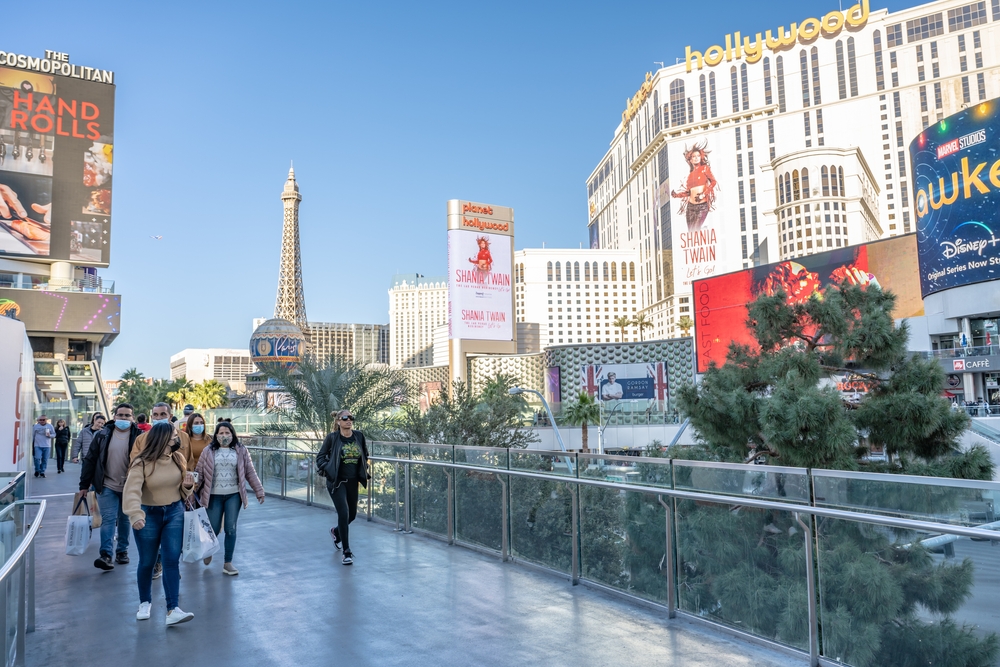
First, it is the law right now. The Sun reported that the ordinance makes it a violation to stop, stand or do anything that causes another person to stop or stand in the flow zones. Those zones cover the bridges and up to 20 feet around the connecting stairs, elevators and escalators. A violation is a misdemeanor that can bring up to six months in jail, a fine of up to $1,000, or both. If you are on a bridge for a show, a game or a night out, keep moving.
Second, there are exceptions worth knowing. According to the Sun, you are not breaking the rule if you have to stop while waiting to use the stairs, elevators or escalators near a bridge. Stopping by accident because of picketing on the sidewalk below is also not a violation. And when the ordinance passed, Clark County said in a statement that it should not be read to mean people cannot take photos while on a bridge. The county said the point is to keep people moving safely.
Third, think about who actually uses these bridges. Tourists, yes. But also the tens of thousands of locals who work in the resorts, plus residents who go to concerts, sporting events and the Las Vegas Grand Prix. Big events are exactly when the bridges get crowded and exactly when this rule matters most. When FOX5 covered the vote in January 2024, Metro Undersheriff Andrew Walsh said enforcement would start with signs and verbal warnings, with citations or arrests for people who refuse to comply.
Fourth, the outcome reaches beyond the bridges. Peterson told the Sun he worries that if the rule stands, similar limits could spread to other sidewalks in the resort corridor or to the Fremont Street pedestrian mall. The county has not proposed anything like that. But that is part of why both sides are taking this appeal seriously. The case will help define how much room local government has to manage crowded public walkways.
It helps to understand the two legal ideas in plain English. The ACLU's main argument is that the rule is too vague. In law, a rule is vague when a regular person cannot tell ahead of time what is allowed and what is not. If you cannot tell whether pausing for five seconds to snap a picture counts as "stopping," the ACLU says, the rule is unfair. The county's side, and the judge's ruling, rest on a different idea: government can set reasonable rules about the time, place and manner of activity in public spaces, as long as the rules are narrow and leave other options open. Dorsey found the bridges are a small piece of the walking system and the street-level sidewalks remain open for stopping, so she sided with the county. The 9th Circuit will now weigh both of those ideas again.
Background and History
The Clark County Commission passed the ordinance unanimously in early January 2024. County commissioners and Metro Police raised safety concerns. The Sun reported that a study by Sousa found the bridges make up less than 6% of the length of the resort corridor's sidewalk system but account for 11% of "disorder" calls on the Strip to Metro.
The ordinance itself cites data showing calls for police service on the Strip rose 29%, from 37,598 in 2018 to 48,358 in 2022. Officials also pointed to crowd crush, which is when people are packed so tightly they can be injured or killed. The Sun noted that the bridges are narrow and have limited ways in and out, which makes them more prone to that kind of danger. Walsh told commissioners in 2024 that it is hard for officers to get onto the bridges when they are packed.
The resort industry backed the rule. Nevada Resort Association president Virginia Valentine told commissioners in 2024 that "the bridges were designed to convey pedestrians from one side to the other and for no other purpose." She asked them to see the ordinance as "an ounce of prevention" in case a bridge ever had to be cleared quickly or reached by first responders.
The Sousa study used a broad definition of "disorder." Nevada Current reported that the study described it as behavior that is not always illegal but is a problem in public places, such as aggressive panhandling, illegal vending, street scams and drug activity. That is the kind of activity the county said it wanted to keep from bunching up on narrow bridges.

The ACLU of Nevada said from the start that it would challenge the rule in court. In February 2024, it sued on behalf of Lisa McAllister, a wheelchair user with a spinal cord condition, and street performer Brandon Summers. Another street performer, Jordan Polovina, later joined the case. The complaint argued that the ordinance violates the First and 14th Amendments and does not make room for protected activities such as holding signs. The case worked its way through federal court for more than two and a half years before Dorsey ruled for the county in September 2026.
This also is not the first time a big tourist city has tried to manage foot traffic this way. Nevada Current noted in 2024 that New York City passed a law in 2016 that set up pedestrian flow zones in Times Square and kept street performers and costumed characters out of them. Las Vegas took a similar approach on its overpasses.
One of the plaintiffs has a history with the bridges. Nevada Current reported that in 2018, Brandon Summers, a violinist and educator, was told by a Metro officer to leave a skybridge where he was packing up after playing. When he later filmed officers dealing with a man selling bottled water, police took his phone and arrested him. He was charged with obstructing the sidewalk, the charge was dropped, and Metro eventually paid $100,000 after he sued. That history is part of why street performers have been central to this case.
What Happens Next
Now the case moves to the 9th Circuit. Federal appeals usually follow a set path. Both sides file written briefs laying out their arguments. The court may hold oral arguments, where lawyers answer questions from a panel of judges. Then the panel issues a written decision. That process often takes many months. No schedule for this appeal has been announced, so there is no date yet for a decision.
In the meantime, nothing in the reporting suggests the ordinance has been put on hold. Dorsey upheld it, so it remains in force while the appeal plays out. If the 9th Circuit agrees with Dorsey, the rule stays. If it sides with the ACLU, it could strike down all or part of the ordinance or send the case back to the lower court. Either side could then try to take the case further.
It is also worth knowing what the appeal does not do. It does not change the rules for the street-level sidewalks along Las Vegas Boulevard, where stopping and standing are still allowed. It does not cover the Fremont Street pedestrian mall downtown, which sits inside the City of Las Vegas, not the unincorporated county land this ordinance covers. And it does not stop the county from adjusting the ordinance on its own if commissioners decide to, though nothing like that has been proposed.
For Las Vegas residents, the practical timeline is simple. The bridge rules apply now, including during the busy holiday season and the Grand Prix weekend in November. Watch for news from the 9th Circuit in 2027 or later.
Ryan's Take
This is not a housing story, and I will not pretend it is. But I think it is worth knowing about, because the resort corridor is the engine of our local economy. A lot of my clients work on the Strip, and a lot of the jobs that pay our mortgages run through those resorts. How the county keeps the corridor safe and moving matters to them. The court will sort out the constitutional questions, and I am not going to pick a side on the legal arguments. What I care about is that locals know the rules so they do not get a ticket on their way to a concert.
I will add one more thought. The Strip keeps getting busier with major events, from the Grand Prix to big concerts, and new venues keep coming. More events mean more crowds on the same narrow bridges. Whatever the court decides, the county is going to keep looking for ways to move people safely through the corridor. That affects everyone who works there, and a lot of the people who work there are my neighbors and clients. Knowing the rules is just part of living in a city built around big crowds.

What You Can Do
When you cross the Strip on foot: Keep moving on the bridges and near the stairs, elevators and escalators. If you want a photo of the Strip, take it from the street-level sidewalk, where stopping is still allowed. Waiting in line for an elevator or stairs is fine.
On big event nights: Expect crowded bridges before and after concerts, fights, games and the Grand Prix. Plan an extra few minutes to cross, stay with your group, and do not stop at the top of an escalator or staircase to regroup. Step off to a street-level sidewalk first.
If you have friends or family visiting: Give them a heads-up. Most visitors have no idea the rule exists, and the bridges are the most natural place to stop for a picture.
If you want to follow the case: The appeal will be decided by the 9th U.S. Circuit Court of Appeals. Clark County Commission agendas are posted online if the county ever changes the ordinance, and public comment is open at those meetings.
Have questions about how this affects your home or neighborhood? Reach out to Ryan Rose or text/call 702-747-5921 anytime. Ryan Rose | Real Broker, LLC | 702-747-5921 | ryan@rosehomeslv.com | rosehomeslv.com
Sources
Las Vegas Sun: "ACLU appeals ruling on Las Vegas Strip pedestrian bridge restrictions" (Grace Da Rocha)
FOX5 Vegas: "New pedestrian bridge ordinance to face legal challenge"
Nevada Current, republished by ACLU of Nevada: "County criminalizes stopping for a selfie on Strip pedestrian bridges" (Dana Gentry)
Categories
- All Blogs (5068)
- Absentee Owner (4)
- Affordability (3)
- ALIANTE (53)
- Anthem (33)
- Ascension (50)
- Assumable Loan (1)
- Astra (50)
- BLACK MOUNTAIN (55)
- Buyers (22)
- Cadence (17)
- Calico Ridge (50)
- Canyon Fairways (50)
- CANYONS OF SUMMERLIN (55)
- CENTENNIAL HILLS (81)
- Comparisons (46)
- CROSSINGS IN SUMMERLIN (55)
- DESERT SHORES (47)
- Divorce (3)
- Downsizing (13)
- EAGLE HILLS (55)
- Empty Nester (1)
- Enterprise (1)
- EXPIRED LISTINGS (134)
- First Time Homebuyer (4)
- Green Valley (139)
- Henderson (82)
- HORIZONS EDGE (50)
- Housing Market Trends (100)
- Informative (112)
- Inspirada (58)
- Lake Las Vegas (2)
- Lakes Las Vegas (3)
- Las Vegas Real Estate (183)
- Local News (842)
- Luxury (1)
- MacDonald Highlands (88)
- MacDonald Ranch (100)
- Madeira Canyon (93)
- MESQUITE NV (103)
- MOUNTAIN TRAILS (50)
- Mountains Edge (79)
- Naked City (35)
- New Construction (131)
- New Construction Las Vegas (20)
- North Las Vegas (24)
- Northgate (23)
- PALISADES SUMMERLIN (50)
- Probate (28)
- Providence (2)
- Quail Ridge (35)
- QUEENSRIDGE (56)
- Red Rock (1)
- RED ROCK COUNTRY CLUB (60)
- Relocating to Summerlin (207)
- Relocation (45)
- Retired (1)
- Retirement (1)
- Reverence (15)
- RHODES RANCH (64)
- Ridgebrook (40)
- Sellers (255)
- Seven Hills (83)
- Silverado Ranch (1)
- Silverstone Ranch (39)
- SKYE CANYON (100)
- SKYE CANYONE (4)
- Southern Highlands (94)
- Southwest (19)
- SPANISH TRAILS (55)
- SPRING VALLEY (70)
- Summerlin (104)
- Sun City Summerlin (3)
- The Arbors (37)
- The Cliffs (50)
- THE HILLS (55)
- THE PASEOS (55)
- The Pueblos (27)
- THE PUEBLOS OF SUMMERLIN (42)
- THE RIDGES (65)
- THE VISTAS OF SUMMERLIN (50)
- The Willows (60)
- Thoughts on Home Tour (2)
- TOURNAMENT HILLS (50)
- Veterans (3)
- WHITNEY RANCH (55)
- Workers Advantage Program (100)
Recent Posts



GET MORE INFORMATION