
Brightline West Funding Explained: The $6 Billion Loan That Decides the Vegas Train
Related Stories
Brightline's Florida Bankruptcy Does Not Change the Vegas Train
Brightline West and Florida's Chapter 11 Filing
Harry Reid Airport Traffic Fell 9.2 Percent in August
The Brightline West train from Las Vegas to Southern California now costs about $20 billion, and the company has only about $5.5 billion of public money locked in. The biggest missing piece is a $6 billion federal loan that is still under review, and whether it comes through will decide if the late 2029 opening date is real.
Brightline West says its sister company's bankruptcy in Florida does not change any of this. We covered that news in Brightline's Florida Bankruptcy Does Not Change the Vegas Train. This piece goes one layer deeper. It explains where the money for the Vegas train comes from, why the price more than doubled, and which deadlines over the next few months will tell you the most.
If you own a home in the southwest valley, commute on I-15, or just want to know whether this train is really coming, this is the plain-English version of the money behind it.
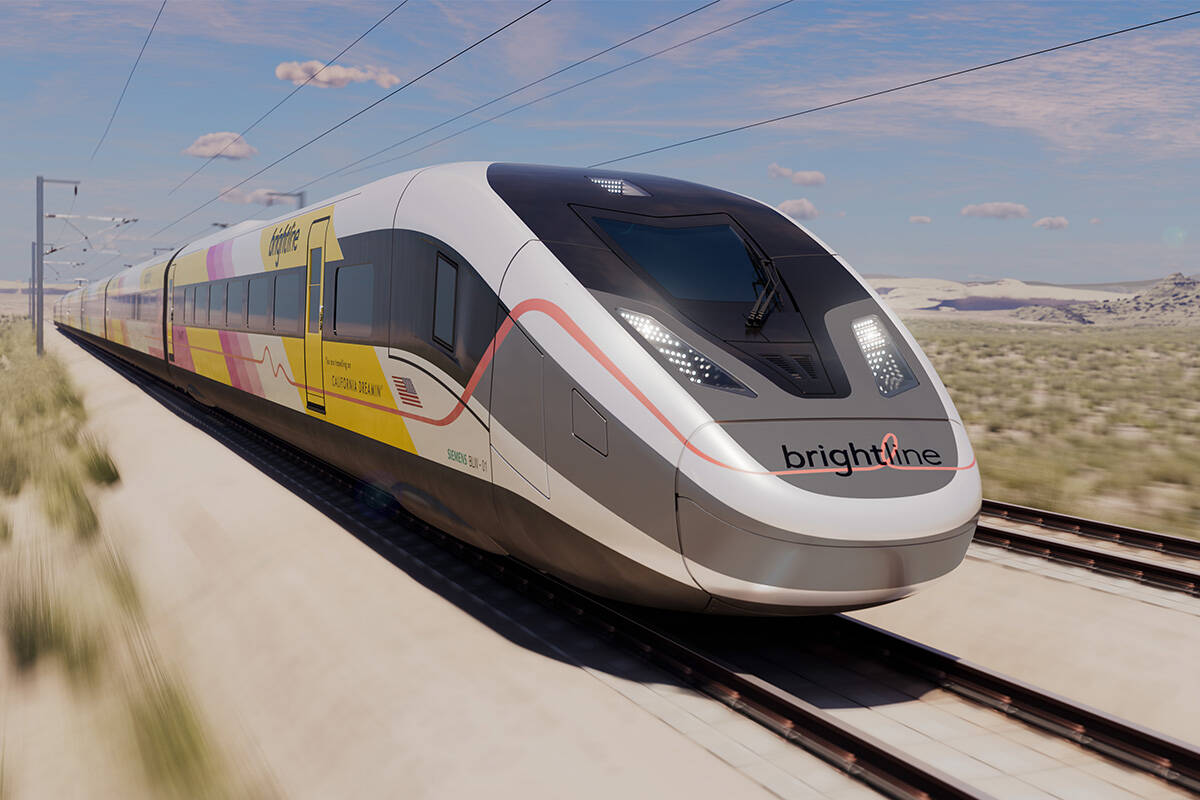
What Happened: The Funding Stack, Piece by Piece
Think of the project's money like a stack of blocks. Each block comes from a different place, with its own rules. Here is what the stack looks like today, based on reporting from the Las Vegas Review-Journal, KTNV 13, and the municipal finance trade paper The Bond Buyer.
Block one: a $3 billion federal grant. In 2023, Brightline West landed a $3 billion grant from the Federal Railroad Administration. The money came from the Bipartisan Infrastructure Law. A grant does not get paid back. It is the only piece of the stack that is truly "free" money, and it was awarded through the Nevada Department of Transportation, which is why NDOT plays a big role in the Nevada side of the work.
Block two: $2.5 billion in private activity bonds. Private activity bonds are a special kind of bond that lets a private company borrow money at tax-exempt rates for a public-type project, like a rail line. Investors buy the bonds, and the company pays them back with interest. Nevada and California issued the bonds for Brightline West, and The Bond Buyer reports they were originally sold in February 2025. These bonds are debt, not a gift. They have to be repaid.
Block three: the $6 billion federal loan. On Sept. 26, 2025, Brightline West applied for a $6 billion loan through the federal Railroad Rehabilitation and Improvement Financing program, known as RRIF. The program is run by the U.S. Department of Transportation's Build America Bureau. Smart Cities Dive reports that RRIF loans carry low interest rates and can be paid back over as long as 35 years. A year after applying, Brightline West is still waiting for an answer.
Block four: bank loans and owner equity. In March 2026, The Bond Buyer reported that a banking group was lined up for a $4 billion senior loan. A managing director at Fortress Investment Group, the company that owns Brightline, said the banks were "prepared to sign," but that their funding was "ultimately conditioned on the RRIF loan's execution." In plain terms, the bank money is waiting on the federal loan. On top of that, Brightline's leaders told Bloomberg, as reported by Trains magazine, that the company would raise equity, meaning money put in by owners and investors, to cover most of the recent cost increase.
Why It Matters to Las Vegas Residents
Here is the simple math. The grant and the bonds add up to $5.5 billion. Add the $6 billion federal loan and the $4 billion bank loan, and you reach $15.5 billion. The rest of a roughly $20 billion project has to come from equity. That is why the $6 billion loan matters so much. It is not just one block in the stack. Because the banks have tied their money to it, the federal loan is the block holding up two other blocks. If it falls through, about $10 billion of planned funding is in question at once.
For people who live here, that matters in three practical ways. The first is the station site. The Las Vegas station is planned for Las Vegas Boulevard between Blue Diamond Road and Warm Springs Road, on a 110-acre property. That is close to Southern Highlands, Silverado Ranch, Mountains Edge, and the Enterprise area. A fully funded project means steady construction and, eventually, a busy transit hub. A funding gap means the land keeps waiting.
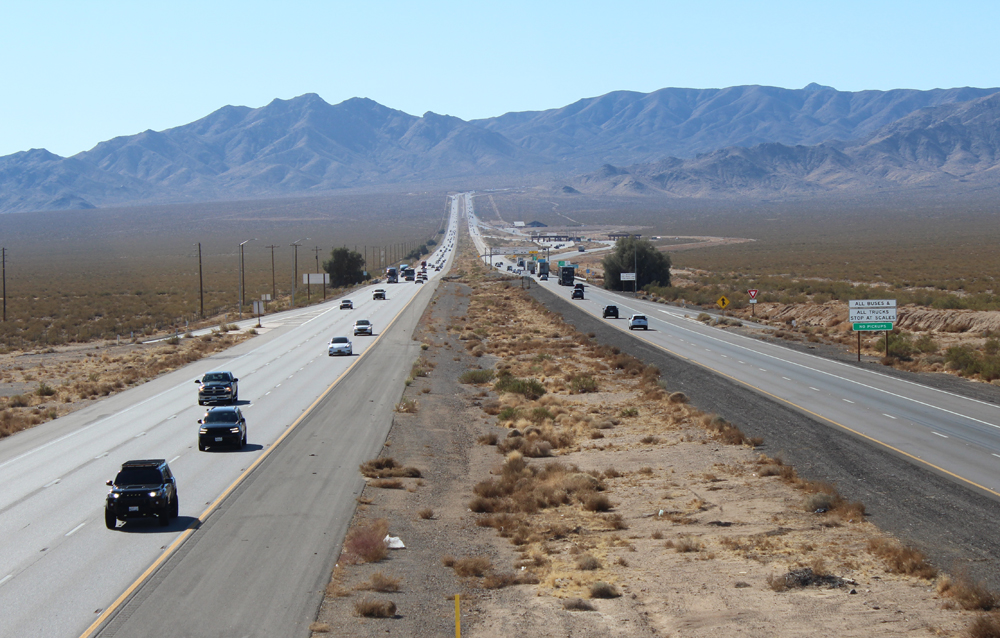
The second is I-15. Anyone who drives to Southern California knows the Friday and Sunday crawl through the desert. The train is the only big new option on the table for that drive. Every month the money is not finished is another month the opening date is at risk, and the late 2029 target already replaced an earlier goal of opening for the 2028 Los Angeles Olympics.
The third is jobs and visitors. Brightline West is mostly a project to bring Southern Californians here. That supports the resort economy that pays a lot of local paychecks. Our tourism numbers already show some softness, with Harry Reid Airport traffic down 9.2 percent in August. A new way to get drive-in visitors to town would matter more, not less, in a slower year. But none of that happens until the funding is complete.
It is also worth knowing how much risk is being shared with taxpayers. Brightline West has long been described as a private rail project. The grant is public money. The bonds use a federal tax break. The loan, if approved, would be a federal loan. That does not make the project good or bad. It just means the public has a real stake in whether the numbers hold up, and so do the homeowners who live closest to the station site.
Background: Why the Price Went From About $9 Billion to About $20 Billion
The cost of this project depends on which document you read and when. That can be confusing, so here is the short history. The Review-Journal reports that the estimated cost rose last year from $9 billion to $20.1 billion. Other public documents have shown different starting points. The Review-Journal reported in October 2025 that the price had been touted at about $12 billion before a U.S. Transportation Department document listed it at $21.05 billion. The Bond Buyer has described the budget as rising from about $16.1 billion to $21.05 billion, with about $5.3 billion added in the fall of 2025.
The starting numbers differ, but every recent figure lands at about $20 billion to $21 billion. In September 2026, The Bond Buyer reported the remaining budget to complete construction at roughly $20.9 billion.
So why did it jump? Brightline West leaders have pointed to the construction market. Michael Reininger, who leads Brightline West, told the Review-Journal in January that the increase was mainly driven by rising construction costs. He told Bloomberg, as reported by Trains magazine, that higher labor and material costs came from heavy demand for other big projects, including data centers, power plants, and transportation work. In other words, Brightline West is competing for the same workers and steel as many other large builds across the West.
Here is the key point for Las Vegas readers. When the price went up by more than $5 billion, the federal loan became the plan to fill a big part of the hole. Trains magazine reported that the federal loan would take the place of $6 billion in bank funding from the original plan, while new equity would cover most of the increase. That is why the loan went from "nice to have" to "must have."

The bonds have their own story. When the bonds were sold, bondholders set conditions, including a deadline for Brightline West to raise $400 million in equity toward construction. That deadline was first set for March 31, 2026. It was pushed to Aug. 1, then to Sept. 10, and then to Nov. 2, according to the Review-Journal and The Bond Buyer. The Bond Buyer reported the latest change was the fifth amended agreement with bondholders. It also reported that in late August, the senior bonds traded at about 61.5 cents on the dollar. That price tells you investors see real risk, even if they keep giving the company more time.
There has been real progress, too. In March 2026, The Bond Buyer reported that the company cited work on underground infrastructure, column structures, the first elevated deck sections, and 1,300 linear feet of drainage. By September, the company said it had finished negotiating its construction contracts, which locked in major parts of the budget and schedule. One bondholder told The Bond Buyer that the signed contracts provide "greater cost certainty."
What Happens Next: The Dates That Matter
Late October 2026: the federal review. The company has said it expects the Build America Bureau to finish its due diligence on the $6 billion loan by late October. If that happens, Brightline West expects a formal "invitation to apply." That starts a 90-day review period. Do the math, and a final answer on the loan likely would not come before early 2027.
Nov. 2, 2026: the equity deadline. This is the current deadline to raise the $400 million in equity. The Bond Buyer reports it is also the mandatory tender deadline for the bonds, which means bondholders could have their bonds bought back on that date under the terms of the deal. If the deadline moves a sixth time, that tells you the money is still not lined up. If the equity comes in, that is a real step forward.
The bank loans. Watch for news that the $4 billion bank loan has been signed. Because those banks have tied their money to the federal loan, both pieces are likely to move together. If you see a headline about "financial close," that means the full stack is finally in place and heavy construction can ramp up.
The Florida case, from a distance. Brightline West says it is a separate company, and the Florida filing does not touch its funding stack on paper. Still, the same owner, Fortress Investment Group, stands behind both. Lenders and equity investors look at the whole family before they write a check. A smooth Florida restructuring could make the West's pitch to investors easier. A rocky one could make the $400 million equity raise and the bank loan harder to finish, even though the two projects are legally apart.
The opening date. The company confirmed late 2029 as the target to the Review-Journal on Sept. 28. In May, the Review-Journal reported that this timeline depended on heavy construction kicking off this year. With financing still open as October begins, watch closely for any update to that date. Not everyone is convinced the private model works. Alon Levy, a fellow at NYU's Marron Institute, told Smart Cities Dive he expects Brightline West to "pivot to expecting even more federal funds."

Ryan's Take
When clients ask me about this train, they usually ask, "Is it happening?" After digging into the funding, I think the better question is, "Has the money closed?" Right now, the answer is no. The grant and the bonds are real. The construction contracts are signed. But the federal loan is the keystone, the banks are waiting on it, and the equity deadline has moved five times. Those are the facts, and they are neither a disaster nor a done deal.
For the southwest valley, my advice has not changed. Buy a home in Southern Highlands, Silverado Ranch, Mountains Edge, or Enterprise because it fits your life today. Your commute, your schools, your HOA, and your price matter far more than a train that is still raising money. If the loan comes through and crews ramp up on Las Vegas Boulevard, that is a nice bonus for weekend trips to Southern California. If it slips, you still own a home you like. And if you are selling near the station site, I would not lean on the train in your listing until the financing closes. Buyers read the same headlines you do.

What You Can Do
First, put two dates on your calendar: late October for the federal review and Nov. 2 for the equity deadline. Those two milestones will tell you more about this train than any press release. The Review-Journal and KTNV 13 have covered each step of this story, and they are good places to check for updates. If you see the words "invitation to apply" or "financial close," the project is moving forward in a real way.
Second, if you live near the south end of Las Vegas Boulevard, watch the station site between Blue Diamond Road and Warm Springs Road. Construction activity usually follows money. When the financing closes, you should see crews and equipment pick up. That is the best real-world signal you can get from your own car.
Third, if you are thinking about buying or selling in the southwest valley, use today's numbers, not train headlines. Recent sales, days on market, and price cuts on your street tell you what your home is worth right now. I am glad to pull those numbers for you so you can make a decision based on facts. The train may change the south end of the valley someday. Until the money is in place, the neighborhoods already here are what you are buying.
Have questions about how this affects your home or neighborhood? Reach out to Ryan Rose or text/call 702-747-5921 anytime.
Ryan Rose | Real Broker, LLC | 702-747-5921 | ryan@rosehomeslv.com | rosehomeslv.com
Sources
Las Vegas Review-Journal: Brightline's Vegas-to-LA project still on track despite Florida troubles
Las Vegas Review-Journal: Cost of Brightline's Vegas-to-LA project skyrockets in new document
The Bond Buyer: Brightline West bondholders grant more time as $6b federal loan timeline extended
The Bond Buyer: Brightline West cites construction progress, still no federal loan
Smart Cities Dive: Las Vegas high-speed rail project may hinge on $6B federal loan
Trains: Brightline West seeks $6 billion federal loan as construction costs rise
Categories
- All Blogs (4919)
- Absentee Owner (4)
- Affordability (3)
- ALIANTE (53)
- Anthem (33)
- Ascension (50)
- Assumable Loan (1)
- Astra (50)
- BLACK MOUNTAIN (55)
- Buyers (22)
- Cadence (17)
- Calico Ridge (50)
- Canyon Fairways (50)
- CANYONS OF SUMMERLIN (55)
- CENTENNIAL HILLS (81)
- Comparisons (46)
- CROSSINGS IN SUMMERLIN (55)
- DESERT SHORES (47)
- Divorce (3)
- Downsizing (13)
- EAGLE HILLS (55)
- Empty Nester (1)
- Enterprise (1)
- EXPIRED LISTINGS (134)
- First Time Homebuyer (4)
- Green Valley (139)
- Henderson (82)
- HORIZONS EDGE (50)
- Housing Market Trends (100)
- Informative (112)
- Inspirada (58)
- Lake Las Vegas (2)
- Lakes Las Vegas (3)
- Las Vegas Real Estate (182)
- Local News (714)
- Luxury (1)
- MacDonald Highlands (88)
- MacDonald Ranch (100)
- Madeira Canyon (93)
- MESQUITE NV (103)
- MOUNTAIN TRAILS (50)
- Mountains Edge (79)
- Naked City (35)
- New Construction (131)
- North Las Vegas (24)
- Northgate (23)
- PALISADES SUMMERLIN (50)
- Probate (28)
- Providence (2)
- Quail Ridge (35)
- QUEENSRIDGE (56)
- Red Rock (1)
- RED ROCK COUNTRY CLUB (60)
- Relocating to Summerlin (207)
- Relocation (45)
- Retired (1)
- Retirement (1)
- Reverence (15)
- RHODES RANCH (64)
- Ridgebrook (40)
- Sellers (255)
- Seven Hills (83)
- Silverado Ranch (1)
- Silverstone Ranch (39)
- SKYE CANYON (100)
- SKYE CANYONE (4)
- Southern Highlands (94)
- Southwest (19)
- SPANISH TRAILS (55)
- SPRING VALLEY (70)
- Summerlin (104)
- Sun City Summerlin (3)
- The Arbors (37)
- The Cliffs (50)
- THE HILLS (55)
- THE PASEOS (55)
- The Pueblos (27)
- THE PUEBLOS OF SUMMERLIN (42)
- THE RIDGES (65)
- THE VISTAS OF SUMMERLIN (50)
- The Willows (60)
- Thoughts on Home Tour (2)
- TOURNAMENT HILLS (50)
- Veterans (3)
- WHITNEY RANCH (55)
- Workers Advantage Program (100)
Recent Posts





GET MORE INFORMATION
